
Students Study the Lives of Birds at the Van Der Brohe Arboretum
Article written by Brian Henrickson, VDBA Board Secretary.
Original content appeared in the Raider Report, the Two Rivers High School newsletter.
Note: The Van der Brohe Arboretum has 25 nest boxes located across its property. Brian oversees the program to manage and monitor these nest boxes. The following is his report on the 2026 spring season.
****
That characteristic sound of tires turning into the gravel covered parking lot, at the Van Der Brohe Arboretum (VDBA), heightened my excitement to explore this beautiful place for signs of our feathered, winter residents and early migrants. Our mission was to determine who is competing for a temporary home to rear their young. We would search the nest boxes scattered throughout the property to find evidence that would help us identify which species had claimed their spot and who was making some music in the field.
I quickly parked and turned off the key of my silver GMC Canyon and opened the door. I hopped onto the spongy, gravel surface, slung my binocular strap over my head, grabbed the clip board and began walking with my student assistant, Juan Gondarilla. We were greeted by a warm sun but a cooler spring temperature of 55 F. The NE wind was cool, light, and comfortable against our skin. “Just the way I like it!” Juan said, “I like it when it is cold!” It was April 22, Earth Day, and the time showed 1:34 PM.
We were headed for Nest Box #17 (NB #17) to begin our survey activity. Juan put a drill to the “starbit” screw locking the door and reversed it out. When we opened the door we found 12-15 coarse blades of grass indicating some bird was beginning nesting activity. All 23 nest boxes were previously cleaned out by students last September to prepare them for this year’s migrants and they are beginning to return! Based on the materials being used, the likely new tenants are either Tree Swallows or Eastern Bluebirds. We continued on to check the remaining nest boxes on the center transect. We will know more about #17 in the coming days as the residents continue to build.


Onward we went to discover #18 empty and #19 had what appeared to be a half constructed Eastern Bluebird nest. N/B #20 – N/B #23 were empty save for a blade of grass or single pine needle. These are gifts from the male as he tries to entice his mate to accept his idea for a “home.” Ultimately, the female has the last word here and makes the final choice.
On May 9, N/B #23 was clearly claimed by this Male Tree Swallow and his mate. Nest construction was under way!
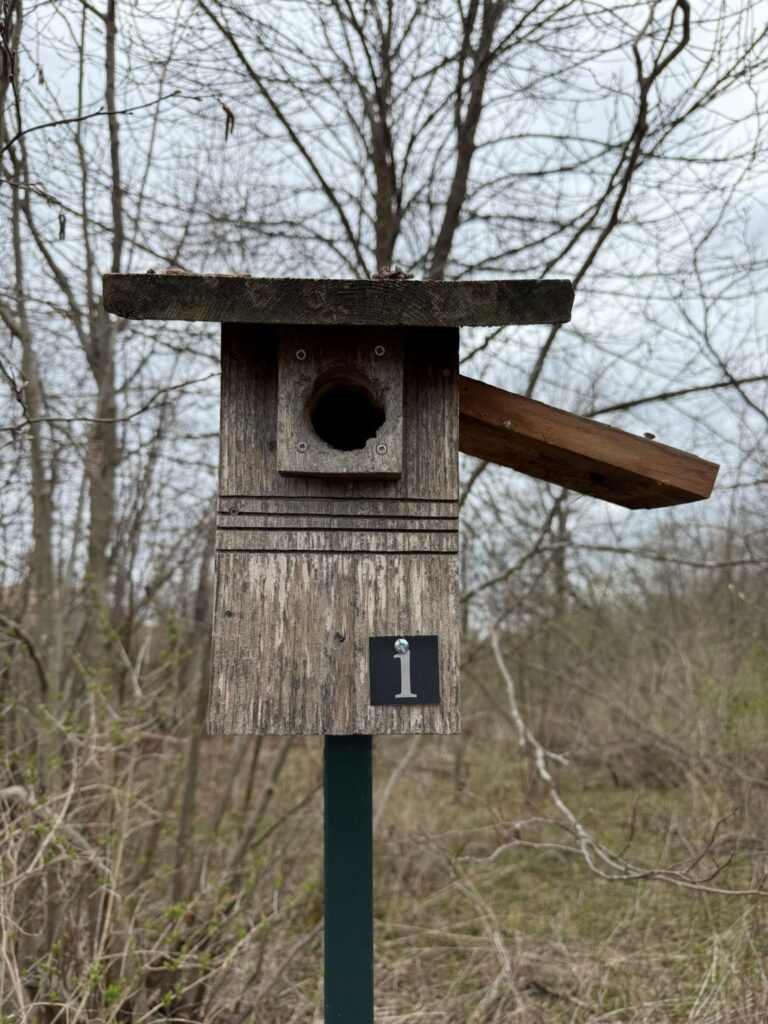
FIRST EGGS of the year were discovered on May 1 in N/B #1 along the Southern transect!! This was exciting news for the team that included Juan, myself, Angel Burdette, and Sarah Ironside. This female, Eastern Bluebird sat tight for a “photo op” but only for a few seconds before flushing from the nest. She left behind four beautiful, blue eggs! This was a great experience for us to witness the flight/fight response behavior of nesting songbirds. If danger is near females will instinctively opt to save themselves instead of their eggs or young. This behavior allows her another opportunity to renest and replace the lost clutch. Little did she know, we were not predators and her future young were safe! She returned to her clutch of eggs a few minutes later while the crew went on to check the remaining nest boxes #2 – #6 but found no additional evidence of occupancy.


We have learned that song birds really change it up from year to year. Last year, there was no activity in N/B #1 until May 26 when a House Wren took up residence. In the 2025 season, the first completed Bluebird nest was discovered in N/B #22 on April 17 when 5 eggs were found there on May 9. The first eggs of 2025 were laid by the European Starling pair taking up residence in the Duck House near the pond. Starlings are invasive species that compete with native birds for nesting cavities. They were first introduced in New York City’s Central Park when 60-100 birds were released in 1890. Today they exist in all 50 states!
One of our future plans with the Nest Box Project at the VDBA is to study site fidelity and competition for breeding sites among species of songbirds. This would require banding the birds to enable us to identify individuals within a population. It would allow us to learn more about their habitat preferences, nesting dynamics, breeding success, and the effects of interspecific and intraspecific competition among the populations. It would also help us measure migratory success and site fidelity among the different species who live here.


The FIRST HATCHLING of the 2026 season was was a House Sparrow in N/B #7, who had laid 5 eggs, and was discovered on May 14 this year. House Sparrows are also Invasives that compete for nesting cavities but have only been observed in the Arboretum this nestbox since 2024. This hatchling was only a few days old!
The last Bluebird egg was laid in N/B #1 on April 30 and hatched a few days after this little hatchling. Our last journey into the field since submitting this article has given us an early story into the lives of our feathered friends. Of the five species that have so far occupied the nest boxes this year, the House Wrens are the most active in obtaining nestboxes, followed by Tree Swallows, Eastern Bluebird, and the Black-capped Chickadee. This time last year the occupancy rate was nearly identical and it will be interesting to compare breeding success data at the end of this season.
2026 Spring occupancy of the 24 onsite Nest Boxes.
- Eastern Bluebirds have occupied 5 nest boxes (21%)
- Tree Swallows have occupied 6 nest boxes (25%)
- House Wrens have occupied 7 nest boxes (29%)
- Black-capped Chickadee have occupied 1 nestbox (0.04%)
- Only 2 nest boxes are still empty (8%)
- House Sparrows have occupied 1 nestbox (0.04%)
- Starlings have not occupied any traditional nest boxes (0%) They only occupied the duck house.
Results show 22/24 (92%) nests were occupied by cavity nesters!


Along with the Nest Box Project, students also had opportunities to help out in other ways at the Arboretum to earn their Community Service hours. Activities included nest box construction and installation, tree maintenance, and trash removal. Students were able to observe and study other wildlife. Kaylae Lewis spent some time observing a fox den. Dakota Denis helped out with removal of tree trunk protectors that were outgrown. He also discovered a few grass snakes for us to play with! Juan helped to set up N/B #24 on May 1 which attracted Tree Swallows within a week! Excellent work Juan!!
We are just passive observers here to bear witness to all the players in the field and to learn their stories of struggles and survival. Some of their family worlds will literally be mingled among human worlds that border this serene sanctuary. For some bird species, this place is just a temporary stop to rest and feed before moving on further north to breed. This journey will even take some to the Arctic! It is peaceful here and spiritual to our minds and bodies that immerse them within. I bring my students here to experience new things and to bear witness to the trials and truths of life in nature. My hope is that they come away with some sense that we too are just a small part of this whole story of our feathered friends and not just someone connected to WIFI or an electric outlet.
